Hey, just so you know, some of the links on this site are affiliate links. That means I may earn a small commission if you buy something through them. It doesn’t cost you anything extra, and it helps me keep this site running. Thanks for your support!
Tennis scoring works in layers: points build games, games build sets, and sets decide the match. The unusual part is the point language—love, 15, 30 and 40—and the requirement to win by two at several stages.
Once those layers are separated, a scoreboard that initially looks strange becomes predictable.
Point scoring inside a standard game
| Points won | Score called |
|---|---|
| 0 | Love |
| 1 | 15 |
| 2 | 30 |
| 3 | 40 |
| 4 | Game, if ahead by at least two points |
If both players reach 40, the score is deuce. From deuce, one player must win two consecutive points: the first creates advantage, the second wins the game.
Why 40–40 does not end the game
A standard game requires a two-point margin. At deuce, winning one point only gives advantage. If the player with advantage loses the next point, the score returns to deuce.
That cycle can continue until one player wins two points in a row.
How games build a set
Under the standard set format described by the ITF, a player or team generally needs six games with a margin of two to win the set. At 6–6, many formats use a tiebreak.
A 7–5 set happens when a player wins two straight games after 5–5. A 7–6 set happens when the players split those next two games and a tiebreak decides the set.
How a standard tiebreak works
The common set tiebreak is first to seven points with a two-point margin. If the score reaches 6–6, play continues until someone leads by two—8–6, 9–7, 10–8 and so on.
Serving order and change-of-ends rules differ from an ordinary game, so viewers should watch the points rather than trying to map tiebreak scores back to 15/30/40.
Best-of-three vs. best-of-five
Most standard matches are best-of-three sets: the first player or team to win two sets wins the match. Some men’s major-championship singles matches use best-of-five: first to three sets.
Tournament rules can also use match tiebreaks or alternative scoring formats, especially in doubles or lower-level events.
What is a match tiebreak?
A match tiebreak can replace a deciding final set in approved formats. One common version is first to 10 points with a two-point margin.
This is different from the standard seven-point set tiebreak. The event’s rules determine which format applies.
How to read a tennis scoreboard
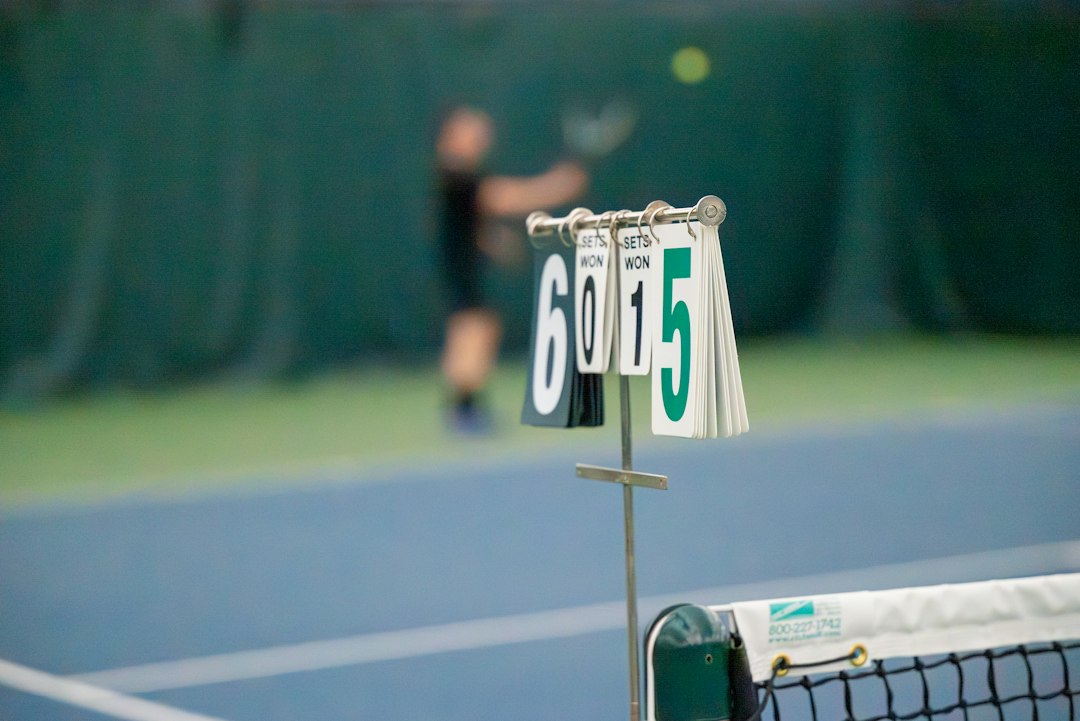
A broadcast scoreboard usually shows the current set score and current game score. For example, a line showing 6–4, 3–2, 30–15 means one player won the first set 6–4, leads the second set 3–2 in games and leads the current game 30–15.
Serving matters to the score display
Broadcast graphics usually mark the current server with a dot, tennis-ball icon or other indicator. The server’s score is still called first when an umpire announces the game score.
FAQ
Why does tennis use 15, 30 and 40?
The scoring language is historical. The current rules define how the sequence works; players do not need to know the origin to follow a match.
What does love mean in tennis?
Zero.
What is deuce?
Forty-all. From deuce, a player must win two consecutive points to win the game.
What does advantage mean?
The player who wins the point after deuce has advantage and wins the game by taking the next point.
How many games are needed to win a set?
Usually six with a two-game margin, with a tiebreak commonly used at 6–6.
How many points win a tiebreak?
A standard set tiebreak is normally first to seven with a two-point margin.
What is a 10-point match tiebreak?
A deciding tiebreak format, often used instead of a final set in certain competitions, played to 10 with a two-point margin.
Are all tennis tournaments scored exactly the same?
No. Alternative scoring, match tiebreaks and event-specific formats exist, so tournament rules should be checked for edge cases.
Bottom line
Think in layers: points → games → sets → match. Love, 15, 30 and 40 only describe the point layer; six-game set targets and tiebreaks sit above it.
Related: Beginner Tennis Racket Guide • Tennis.
Sources
Scoring guidance verified September 30, 2026.