Hey, just so you know, some of the links on this site are affiliate links. That means I may earn a small commission if you buy something through them. It doesn’t cost you anything extra, and it helps me keep this site running. Thanks for your support!
Baseball can feel like an alphabet soup of statistics. Four of the most common abbreviations—ERA, WHIP, OPS and WAR—do not measure the same thing. ERA and WHIP are primarily pitching statistics, OPS is a hitting statistic, and WAR is an all-around value framework designed to estimate how much a player contributes compared with a replacement-level player.
Quick guide: ERA, WHIP, OPS and WAR
- ERA: earned runs allowed per nine innings.
- WHIP: walks plus hits allowed per inning pitched.
- OPS: on-base percentage plus slugging percentage.
- WAR: an estimate of a player’s total value above a replacement-level alternative, expressed in wins.
What does ERA mean?
ERA stands for earned run average. MLB defines it as the number of earned runs a pitcher allows per nine innings. The basic formula is earned runs multiplied by nine, divided by innings pitched.
Lower is generally better because a lower ERA means fewer earned runs allowed. But ERA is not a perfect measure of individual pitching quality. Defense, ballpark environment and what happens to inherited runners can affect the number, so it is best read alongside other pitching statistics.
What does WHIP mean?
WHIP stands for walks and hits per inning pitched. It adds the walks and hits a pitcher allows and divides that total by innings pitched. Lower is generally better.
WHIP answers a useful question: how often is this pitcher allowing runners to reach base through walks and hits? It does not distinguish between the damage caused by different types of hits, and MLB notes that hit batters, errors and fielder’s choices are not included in the standard WHIP calculation.
What does OPS mean?
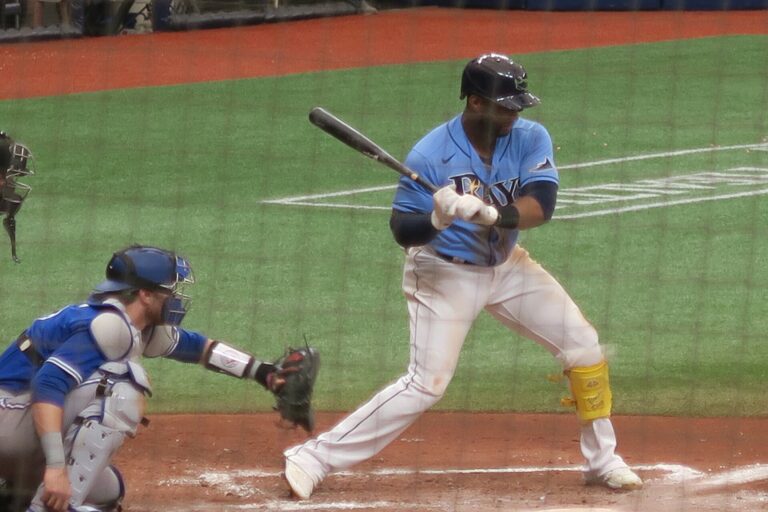
OPS stands for on-base plus slugging. It is calculated by adding a hitter’s on-base percentage (OBP) and slugging percentage (SLG).
OBP measures how frequently a hitter reaches base under the statistic’s rules, while SLG weights hits by total bases. Combining them gives a compact view of a hitter’s ability to reach base and hit for power. Higher is generally better.
You may also see OPS+. Unlike raw OPS, OPS+ adjusts for league and ballpark context and puts league average at 100. That makes OPS+ useful when comparing hitters who played in different offensive environments.
What does WAR mean?
WAR stands for wins above replacement. The idea is to estimate how many wins a player contributes beyond what a readily available replacement-level player would be expected to provide.
For position players, WAR frameworks can incorporate hitting, baserunning, fielding, positional adjustments and league context. Pitcher WAR uses pitching value, but the exact inputs depend on the system.
Why WAR numbers can differ by website
WAR is not one universal official formula. Public systems such as Baseball-Reference and FanGraphs use different implementations, so the same player can have different WAR totals depending on the source. That does not automatically mean one number is wrong; it means you should identify the WAR system before comparing values.
Which baseball stat should you use?
Use the statistic that matches the question. ERA helps summarize earned-run prevention. WHIP focuses on allowing walks and hits. OPS summarizes a hitter’s ability to reach base and hit for power. WAR attempts a broader estimate of total player value.
No single statistic tells the whole story. A better baseball evaluation usually combines multiple numbers with role, playing time, league environment and context.
Keep building your baseball foundation
If you are learning the sport from the ground up, continue with how baseball innings, outs and extra innings work and our guide to what every baseball position does. Together, those explainers give you the game structure and positional context behind the numbers on a box score.
Featured image: generic baseball game imagery by Ryan Kim via Unsplash. It is not presented as a specific MLB game or player.