
Hey, just so you know, some of the links on this site are affiliate links. That means I may earn a small commission if you buy something through them. It doesn’t cost you anything extra, and it helps me keep this site running. Thanks for your support!
College football does scale differently. The biggest stadiums in the sport are not just large by NCAA standards; several rank among the largest sports venues in the United States. For this list, SportsyVibe ranks active college-football home stadiums by their current listed seating capacity as available in 2026, not by record attendance.
Capacity figures can move when renovations, premium seating, accessibility changes or temporary construction alter a venue. Penn State is the biggest current example: Beaver Stadium is in the middle of a major revitalization, so its traditional listed capacity remains useful for comparison while the exact interim game-day configuration can vary. The Rose Bowl is also in an active capital-improvement period. We note those cases instead of pretending stadium capacity is permanently fixed.
If you are new to the structure of the sport, start with our guides to FBS vs. FCS vs. Division II vs. Division III and how the College Football Playoff works. Then come back here for the buildings capable of swallowing an entire small city on a Saturday.
The 10 Largest College Football Stadiums at a Glance
| Rank | Stadium | Primary Team | Location | Listed Capacity |
|---|---|---|---|---|
| 1 | Michigan Stadium | Michigan Wolverines | Ann Arbor, Michigan | 107,601 |
| 2 | Beaver Stadium | Penn State Nittany Lions | University Park, Pennsylvania | 106,572* |
| 3 | Ohio Stadium | Ohio State Buckeyes | Columbus, Ohio | 102,780 |
| 4 | Kyle Field | Texas A&M Aggies | College Station, Texas | 102,733 |
| 5 | Tiger Stadium | LSU Tigers | Baton Rouge, Louisiana | 102,321 |
| 6 | Neyland Stadium | Tennessee Volunteers | Knoxville, Tennessee | 101,915 |
| 7 | DKR-Texas Memorial Stadium | Texas Longhorns | Austin, Texas | 100,119 |
| 8 | Saban Field at Bryant-Denny Stadium | Alabama Crimson Tide | Tuscaloosa, Alabama | 100,077 |
| 9 | Dooley Field at Sanford Stadium | Georgia Bulldogs | Athens, Georgia | 93,033 |
| 10 | Rose Bowl Stadium | UCLA Bruins | Pasadena, California | 90,888** |
1. Michigan Stadium — Michigan Wolverines — 107,601
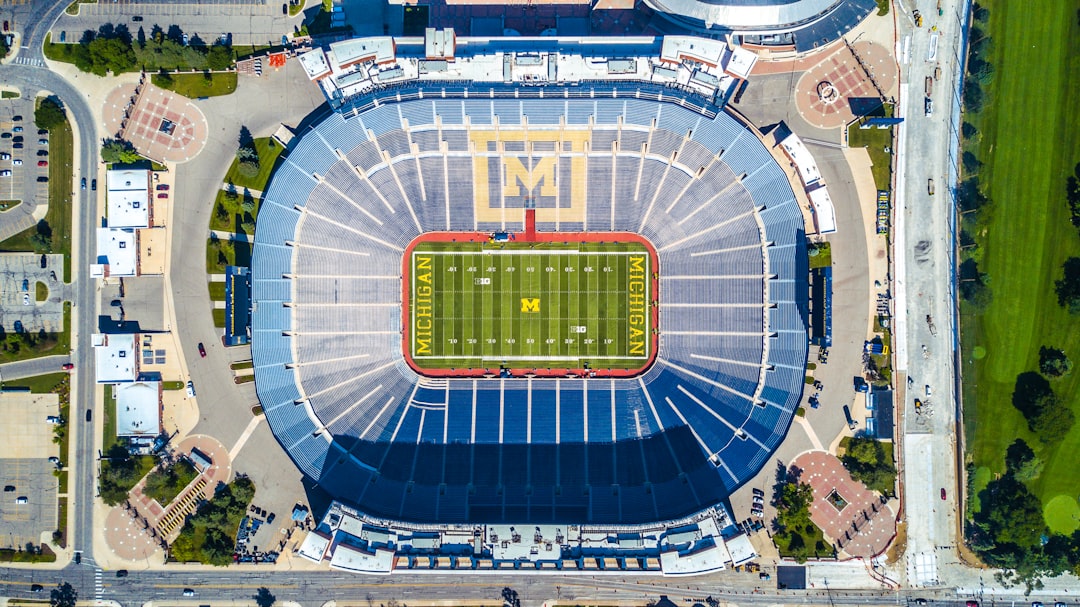
Michigan Stadium is still the benchmark for sheer college-football scale. The Big House opened in 1927 and reaches an official capacity of 107,601, giving Michigan the largest stadium in the United States used regularly for college football. The bowl sits low into the earth, so the structure can look surprisingly restrained from outside before it opens into a massive wall of maize-and-blue seating once you walk in.
Its size is only part of the identity. Michigan has spent decades turning six-figure attendance into routine behavior. The school says the 2026 season is the 99th season of competition at the stadium, while the 100th-anniversary celebration is planned for 2027. The building has also hosted major soccer, hockey and concert events, which reinforces how unusual it is to have a college-owned football venue operating at this scale.
For a capacity list, Michigan is the clean No. 1 because the number is both enormous and stable. It is not a temporary expansion or a one-off bowl-game configuration. More than 107,000 seats are simply the everyday physical reality of Wolverines football.
2. Beaver Stadium — Penn State Nittany Lions — 106,572 Listed Capacity
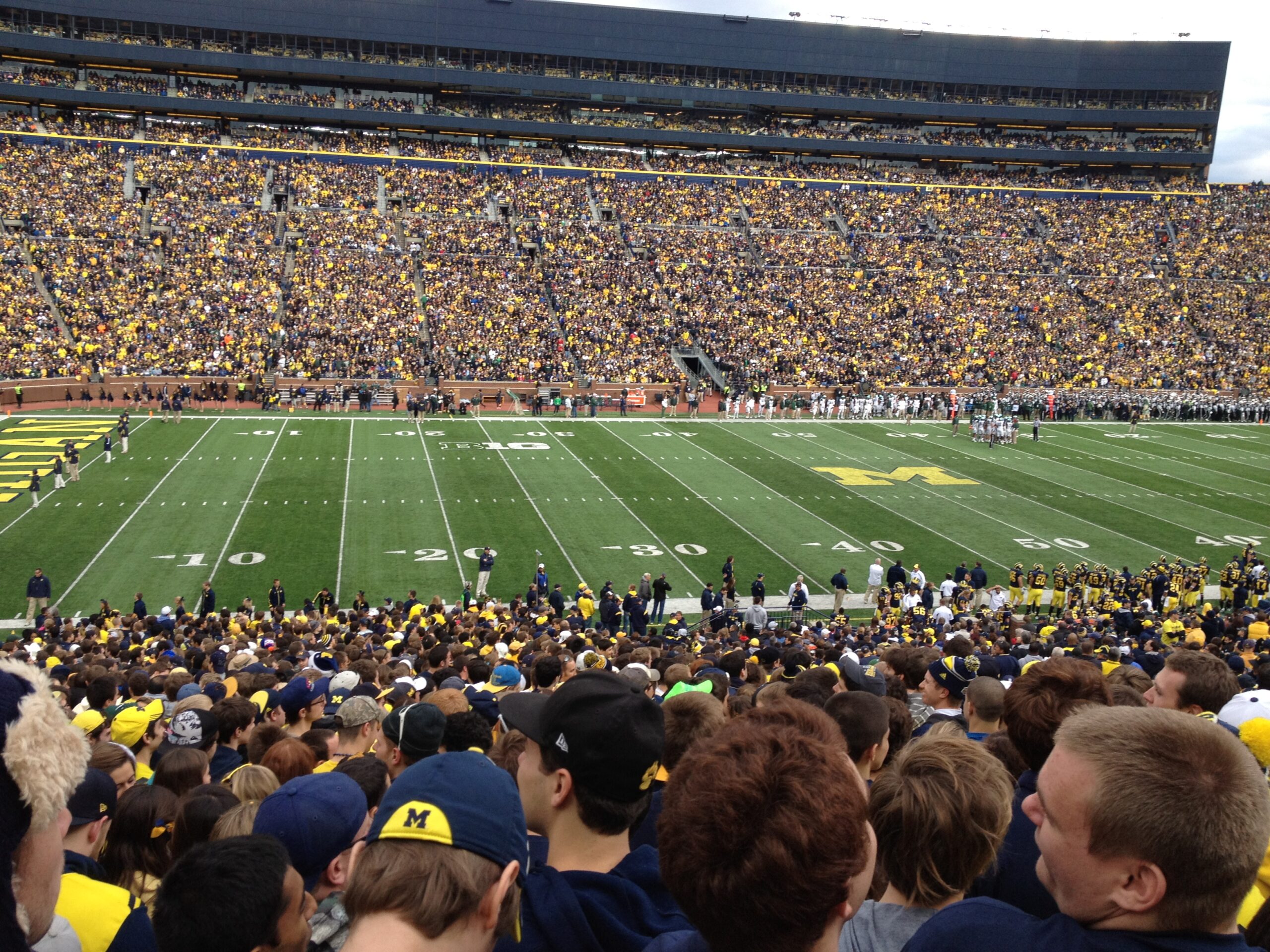
Beaver Stadium has traditionally been listed at 106,572, making it the only college-football home venue that normally sits within striking distance of Michigan Stadium. Penn State’s White Out games show why the building’s reputation goes beyond raw math: when nearly every seat is dressed in white, the size of the bowl becomes visually overwhelming.
The important 2026 wrinkle is construction. Penn State is in the middle of a $700 million revitalization centered on the west side of the stadium. Temporary seating is being used during the 2025 and 2026 seasons, and the school says the venue will remain above 100,000 during the work. Because temporary configurations can change the exact count, 106,572 is best understood as Beaver Stadium’s established listed capacity rather than a promise that every 2026 setup contains precisely that many permanent seats.
The project is scheduled to be complete for the 2027 football season. If the finished seating plan changes the official number, this ranking should be refreshed. Until then, Beaver remains firmly in the No. 2 position because even its construction-era configuration stays in the six-figure club.
3. Ohio Stadium — Ohio State Buckeyes — 102,780
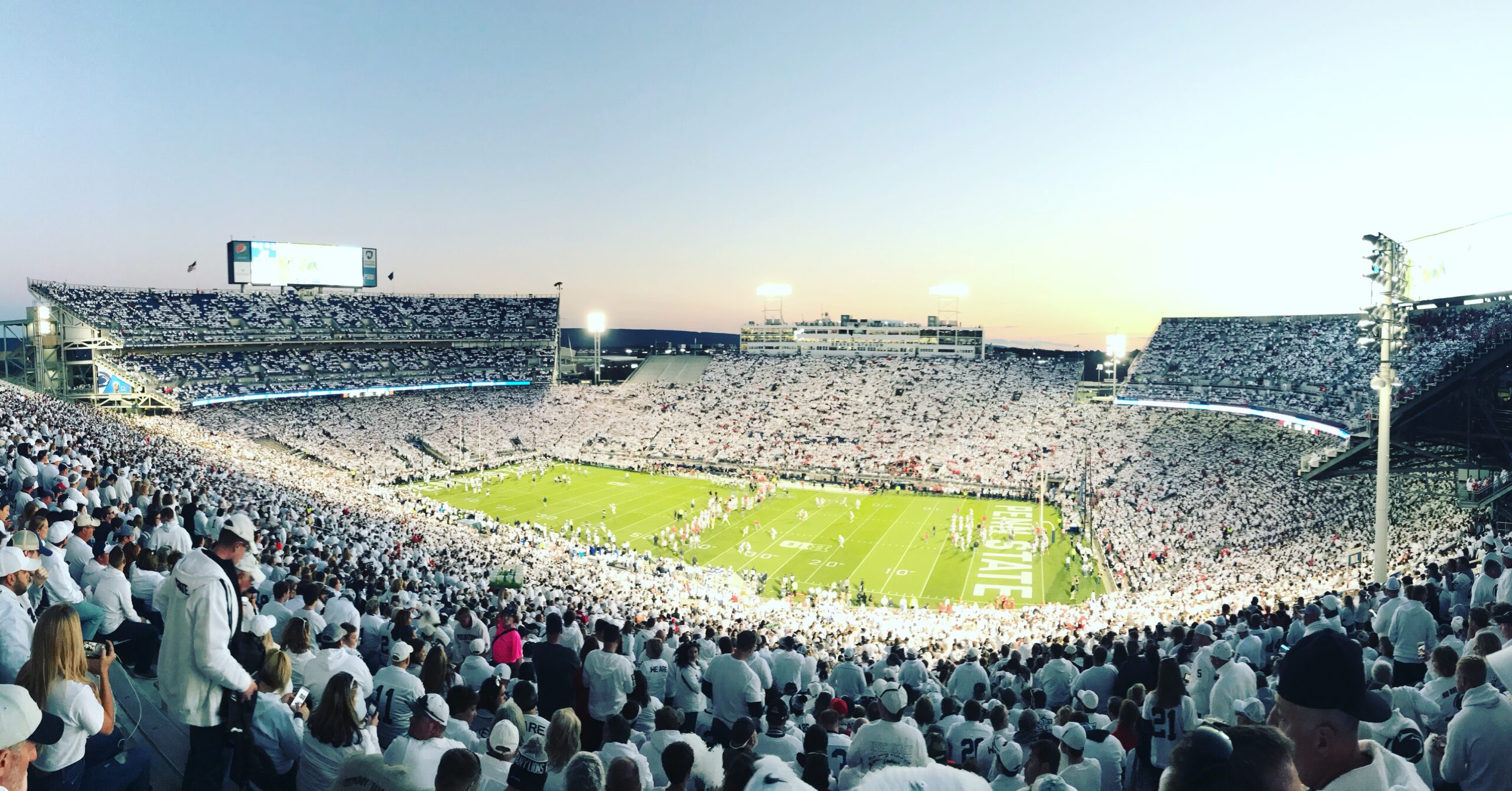
Ohio Stadium has held its place near the top of the sport for more than a century. Opened in 1922, the Horseshoe combines a historic silhouette with a modern official capacity of 102,780. Ohio State’s 2026 football media guide continues to list that figure, making it one of the cleanest current capacity numbers on this list.
The stadium’s shape is a big part of its identity. What began as an open horseshoe has evolved while still preserving the architectural idea that made the venue recognizable. On game day, especially for rivalry games, the bowl compresses more than 100,000 people around the field without losing the sense that you are standing inside one of college football’s historic landmarks.
Ohio Stadium also benefits from an urban campus setting in Columbus. That makes the experience different from more isolated college towns: the stadium is part of a much larger city while still functioning as the center of Buckeye football culture. SportsyVibe recently covered Texas’ dramatic 2026 comeback against Ohio State, another reminder that these giant buildings are compelling because of what happens inside them, not just because of the seat count.
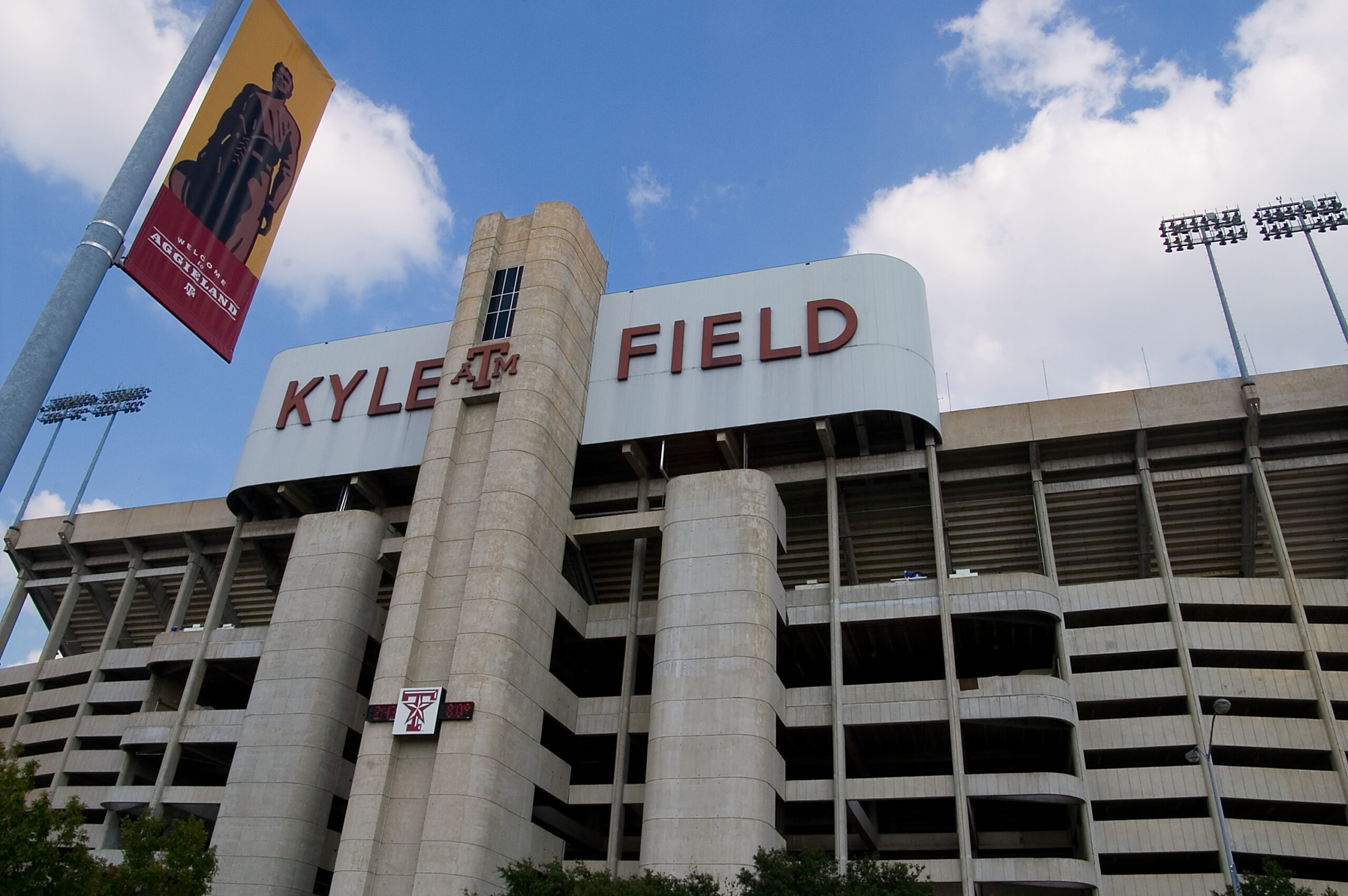
4. Kyle Field — Texas A&M Aggies — 102,733
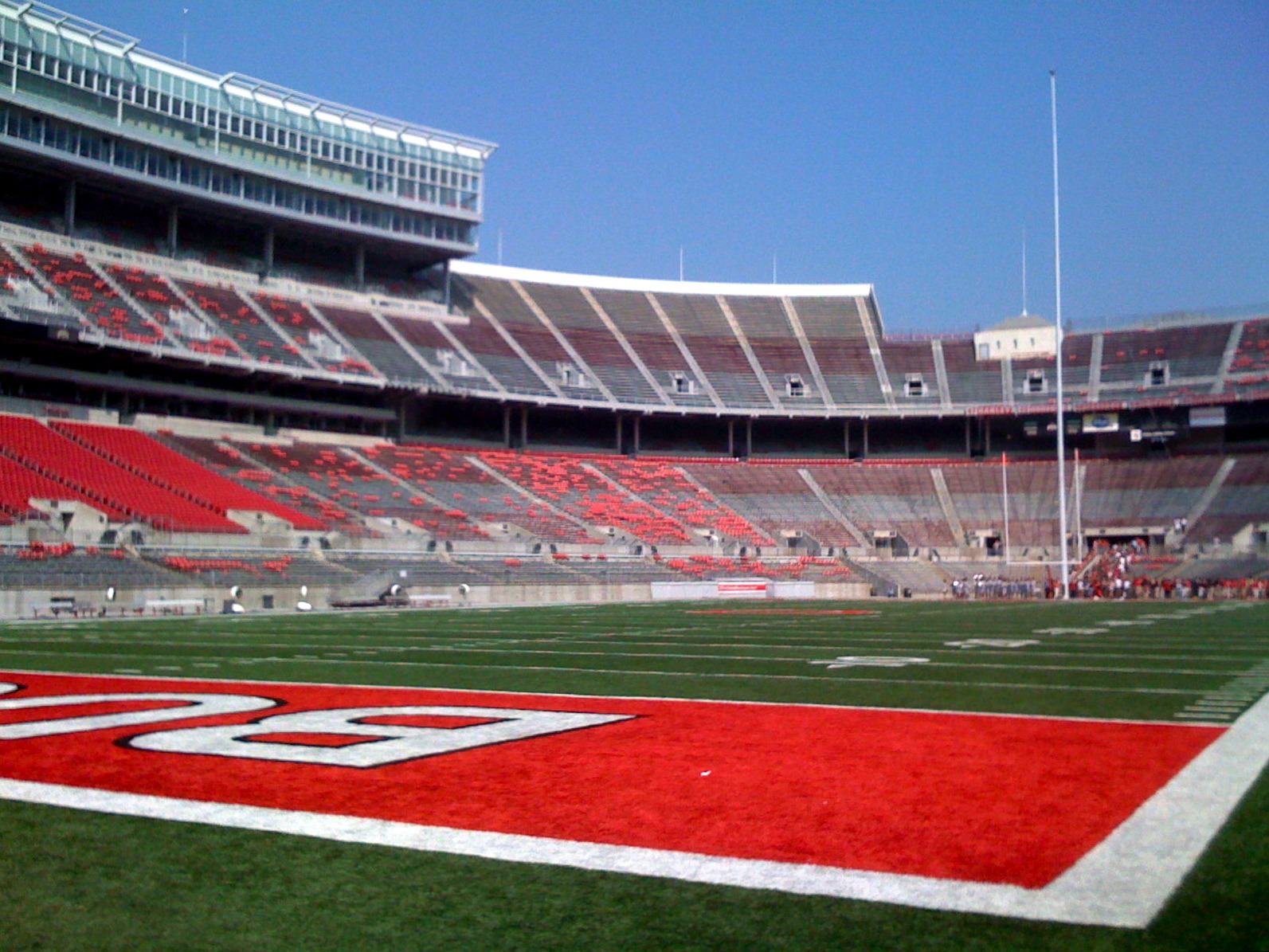
Kyle Field is only 47 seats behind Ohio Stadium on the current listed numbers. Texas A&M’s 2026 game notes continue to identify the building at 102,733, making this one of the closest margins anywhere in the Top 10. The stadium’s modern form is the result of a massive redevelopment that transformed an already famous venue into a much larger and more contemporary facility.
The Aggies call themselves the 12th Man, and Kyle Field is where that idea becomes physical. More than 102,000 fans can turn coordinated traditions, yells and student participation into an atmosphere that feels different from a typical professional stadium. The scale is modern, but the culture around it is highly specific to Texas A&M.
That combination matters when comparing giant college venues. Some stadiums became large because demand forced decades of expansions. Kyle Field went through a major twenty-first-century rebuild while retaining the traditions that created the demand in the first place. Capacity is the measurement here, but the reason the number matters is the audience willing to fill it.
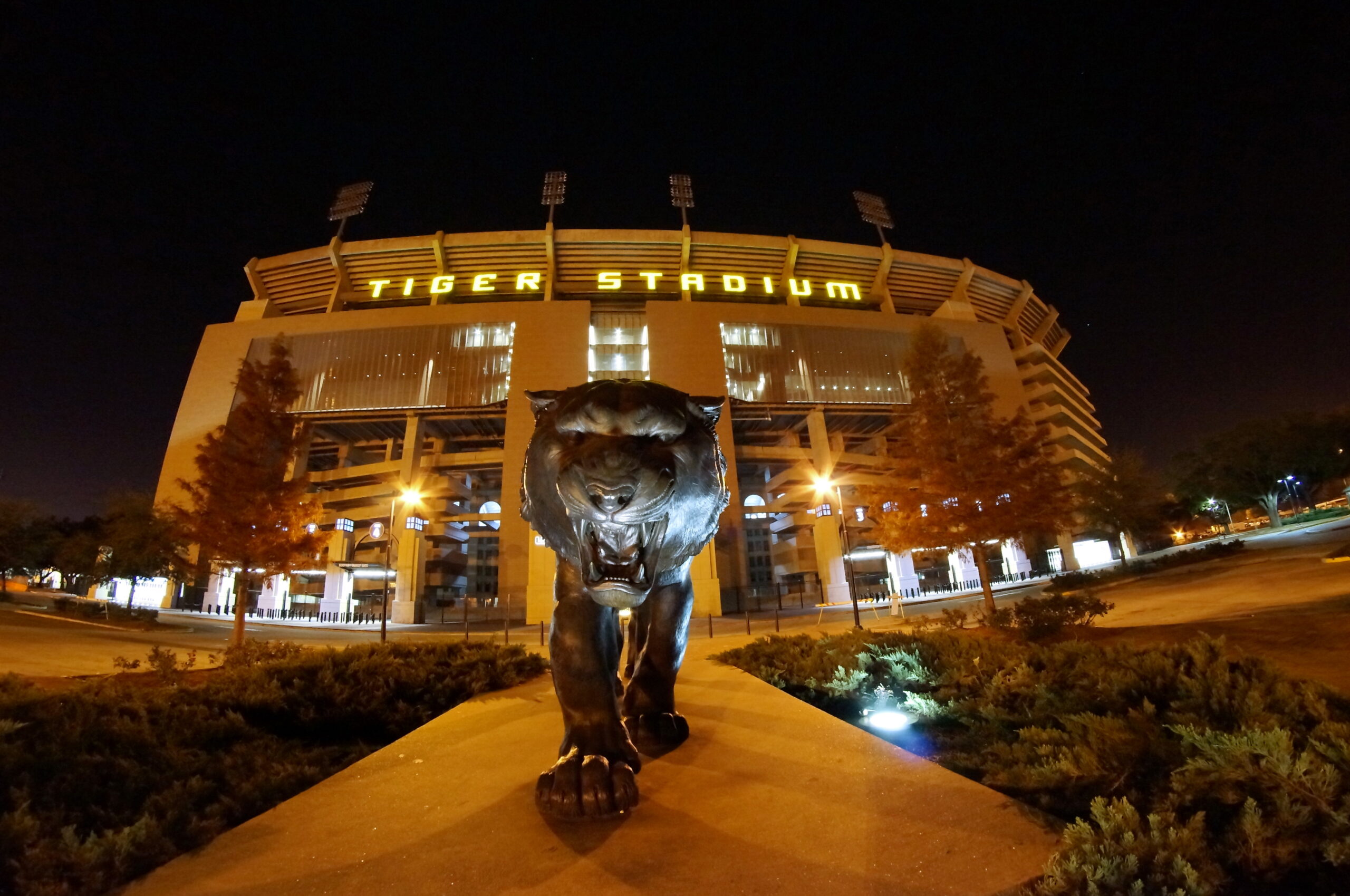
5. Tiger Stadium — LSU Tigers — 102,321
Tiger Stadium’s official capacity of 102,321 puts LSU fifth, but a simple ranking by size understates the building’s reputation. Death Valley is most famous when the sun goes down. Night games in Baton Rouge combine heat, noise, tailgating and a tightly packed crowd into one of the sport’s most recognizable settings.
The stadium reached its current six-figure form after the south end-zone expansion completed before the 2014 season. LSU has continued modernizing the presentation, including major video-board and LED-light upgrades that debuted in 2024. Those changes matter because the biggest old stadiums face a constant challenge: preserve the traditions that make them special while upgrading the technology and amenities fans now expect.
Tiger Stadium succeeds because the architecture is only the shell. The deeper advantage is the ritual around LSU football — the tailgating, the team entrance, the night-game mythology and the crowd’s proximity to the field. At 102,321, there are enough people in that ritual to make the building feel enormous without becoming anonymous.
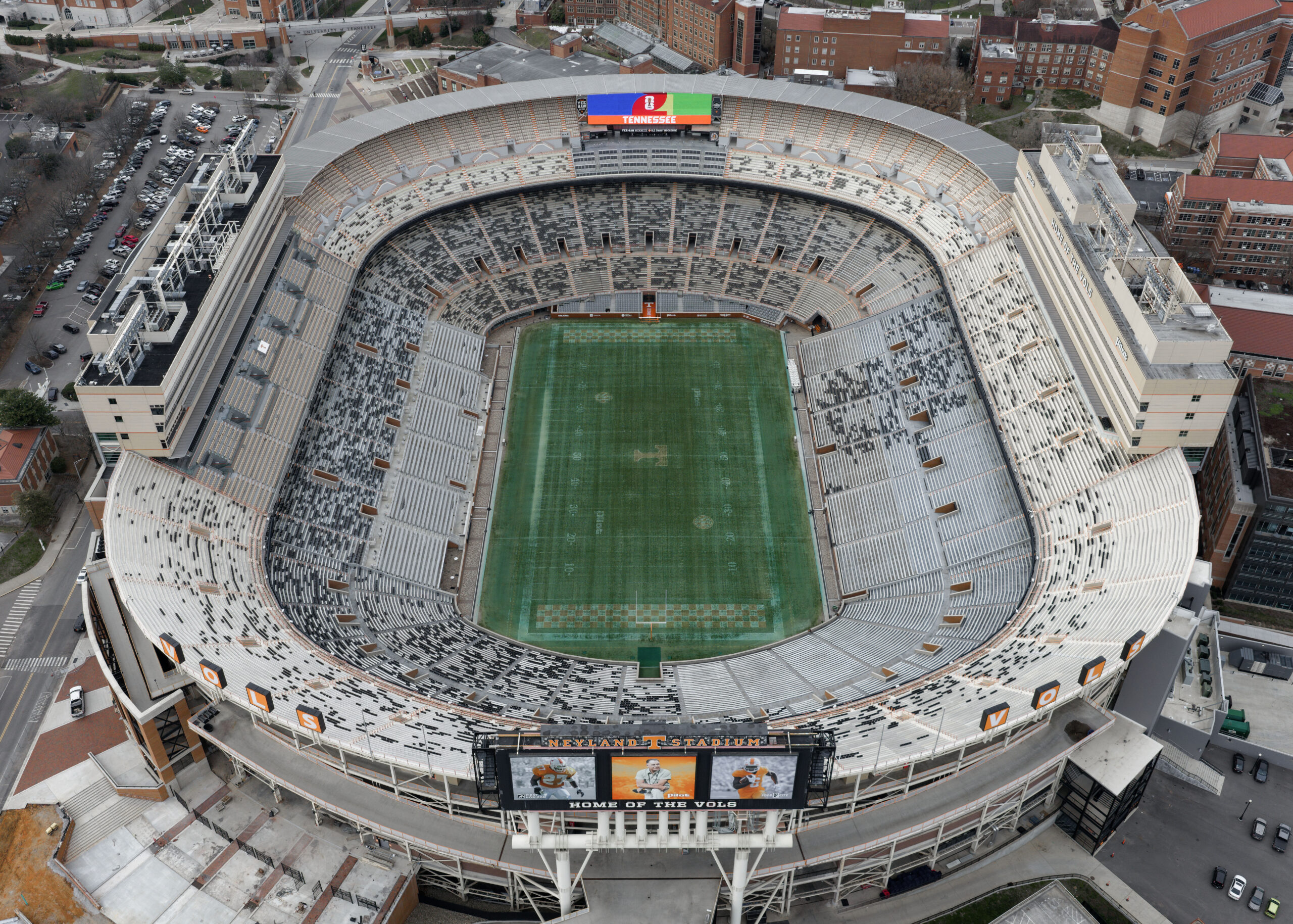
6. Neyland Stadium — Tennessee Volunteers — 101,915
Neyland Stadium sits on the Tennessee River in Knoxville with an official capacity of 101,915. Tennessee Athletics still lists that number for 2026, and the school entered the season with a long sellout streak. The setting is one of the strongest in the Top 10 because the building is embedded in campus and downtown Knoxville while opening toward the river.
Tennessee has spent years renovating Neyland rather than replacing it. The modernization program has touched premium seating, concourses, Wi-Fi, video boards, lighting and fan spaces while preserving the bowl and the visual traditions that make the stadium recognizable. That is the right model for a historic college venue when the structure itself is part of the product.
On Saturdays, Neyland’s size becomes part of the Tennessee identity. The checkerboard crowd designs, orange-and-white color saturation and the Vol Navy arriving by boat turn a 101,915-seat stadium into something that feels connected to the city instead of sealed off from it.
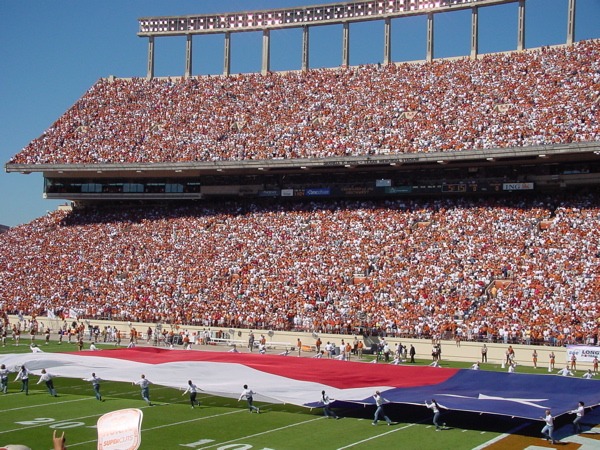
7. DKR-Texas Memorial Stadium — Texas Longhorns — 100,119
Darrell K Royal-Texas Memorial Stadium gives the Longhorns a six-figure home in the middle of Austin. Texas lists the stadium at 100,119, enough to make it one of only a small group of college football venues above 100,000. The building has been expanded repeatedly while becoming more integrated into the larger Texas athletics complex.
The most visible modern change is the redeveloped south end zone, which gave the stadium a more finished, enclosed appearance while adding new team and premium spaces. The result is a venue that still feels historic from the field but increasingly operates like a modern flagship for one of the richest brands in college sports.
DKR also benefits from the collision between campus culture and a major city. Austin is not a traditional isolated college town, and the stadium sits close enough to downtown that Longhorn Saturdays spill into a much larger entertainment ecosystem. The capacity number is huge, but the surrounding market makes the venue feel even bigger.
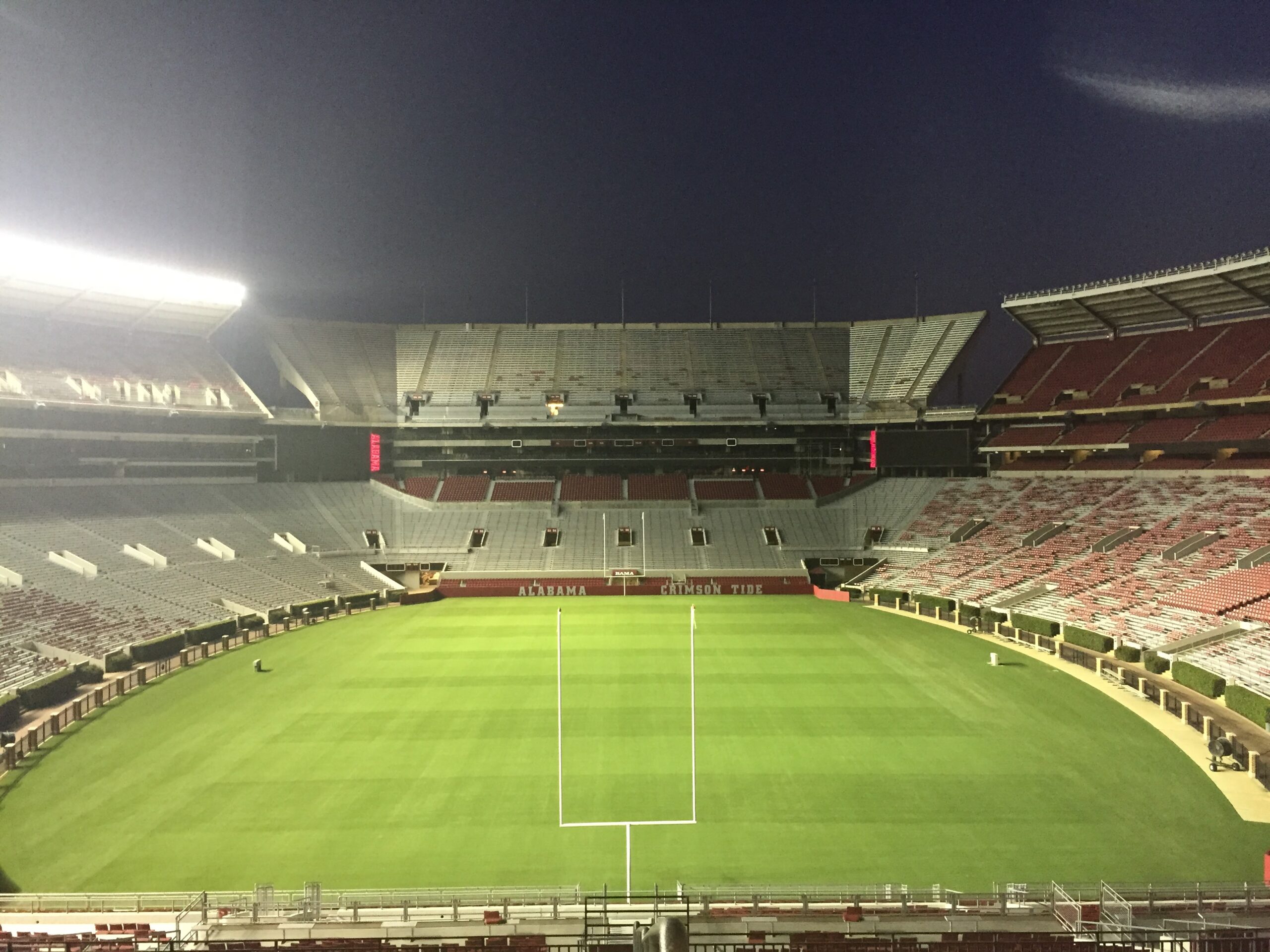
8. Saban Field at Bryant-Denny Stadium — Alabama Crimson Tide — 100,077
Alabama’s home has an official capacity of 100,077, putting Saban Field at Bryant-Denny Stadium just 42 seats behind Texas on the listed numbers. The stadium opened in 1929 and grew alongside the Crimson Tide’s rise into one of the defining programs in college football.
The name now reflects that history directly. In 2024, Alabama named the playing surface Saban Field in honor of Nick Saban while retaining Bryant-Denny Stadium as the building name. That makes the venue a physical timeline of Alabama football, with the names Bryant, Denny and Saban all attached to the same place.
Modern renovations have added premium spaces, technology and upgraded team facilities without changing the essential experience: a huge red-and-white crowd wrapped around a field where national-title expectations are normal. Capacity alone cannot measure pressure, but 100,077 people can certainly help create it.
9. Dooley Field at Sanford Stadium — Georgia Bulldogs — 93,033
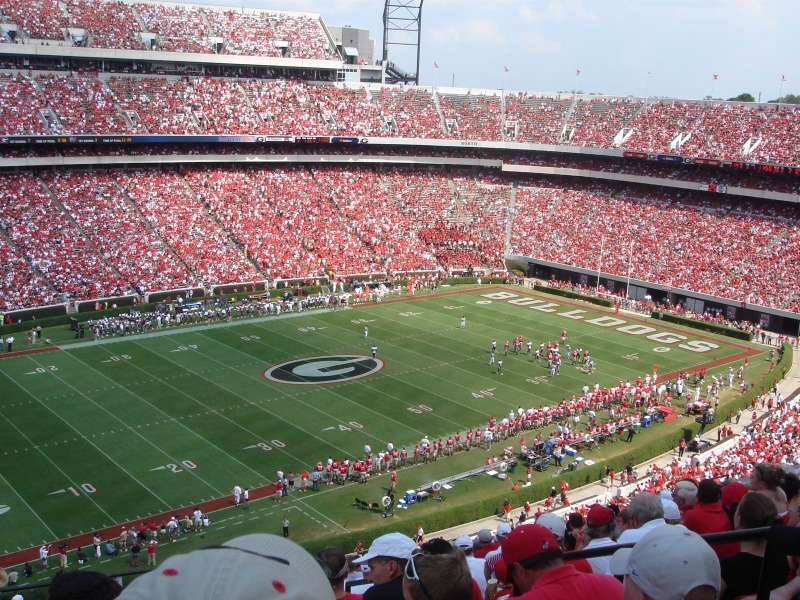
Georgia’s latest facility information lists Sanford Stadium at 93,033 after the 2023-24 renovation program produced a slight capacity increase. That matters because older references still commonly show 92,746. For a capacity ranking, the current school figure is the one that belongs in the table.
Sanford is also one of the most visually distinctive venues here. The field is surrounded by the famous hedges, and the stadium is set into the University of Georgia campus in a way that makes the upper edges of the bowl feel connected to Athens rather than isolated behind giant parking lots. The architecture is large without losing intimacy.
The Bulldogs have added modern team, premium and fan spaces while preserving the “Between the Hedges” identity. At 93,033, Sanford does not reach the six-figure group, but it still holds more people than many NFL stadiums and remains one of the country’s largest active college-football homes.
10. Rose Bowl Stadium — UCLA Bruins — 90,888
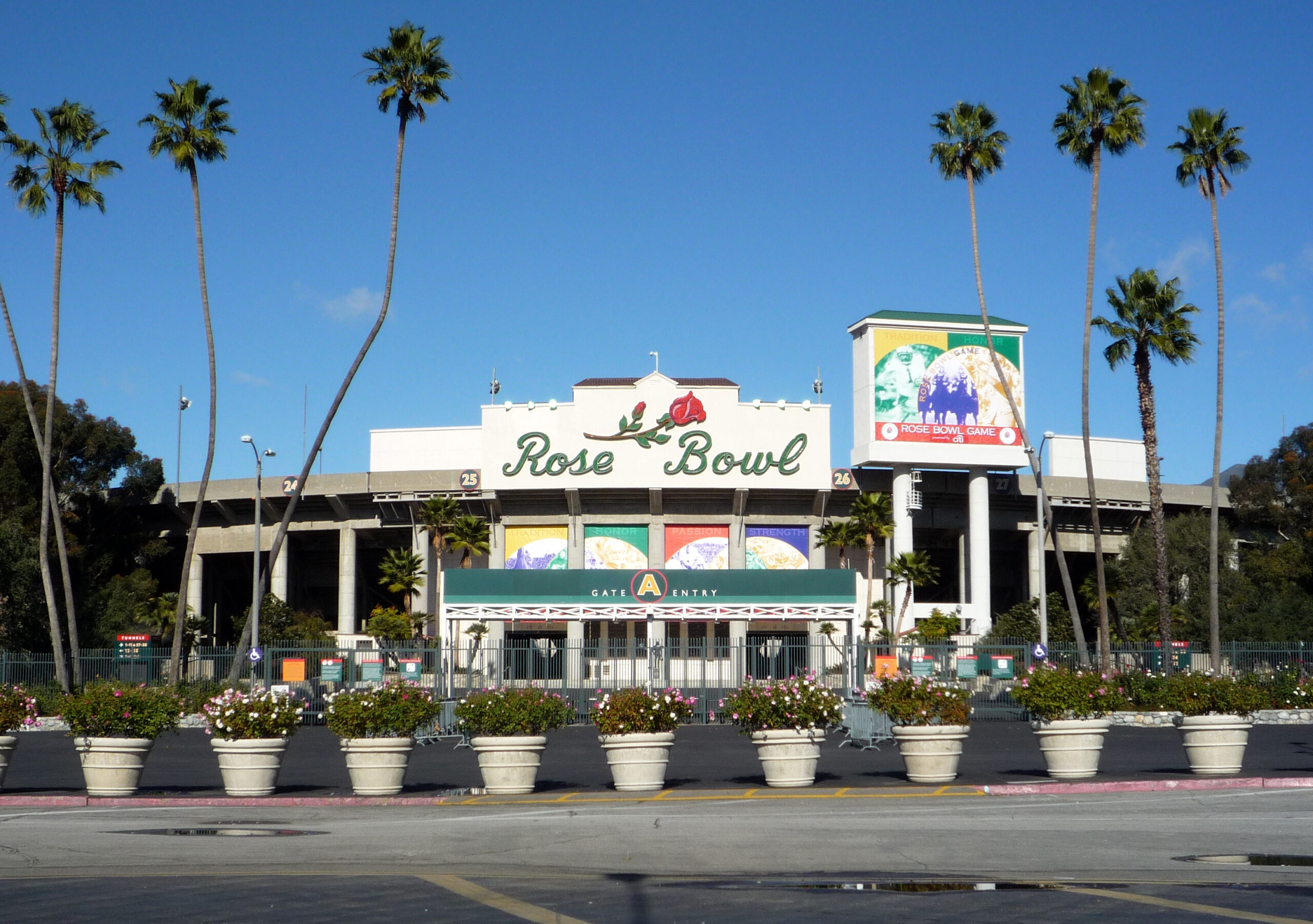
The Rose Bowl is different from every other stadium in this ranking. It is not located on UCLA’s Westwood campus, but the Bruins have used the Pasadena landmark as their home football stadium since 1982. The Rose Bowl Stadium’s current history page lists capacity at 90,888, which keeps it inside the national Top 10 among active college-football home venues.
Capacity at the Rose Bowl deserves a note because the number has changed repeatedly through renovation and event-specific seating configurations. UCLA has historically listed lower football configurations for some games, while the stadium itself has published broader venue capacities. A multi-phase improvement program is also expected to reduce seating over the longer term, so this is one of the entries most likely to move in future editions of this list.
Even with that caveat, the Rose Bowl belongs in the conversation because UCLA is confirmed to play the 2026 season there and the building remains one of the most important stadiums in American sports history. It has hosted Rose Bowl Games, Super Bowls, World Cups and Olympic events. Few college home fields can match that résumé.
What These Giant Stadiums Say About College Football
The most striking thing about this list is that eight of the ten venues hold at least 100,000 people or sit only a few thousand seats below that threshold. College football’s biggest brands built capacity around repeat demand from students, alumni, local fans and generations of families who treat Saturday attendance as tradition rather than occasional entertainment.
The other lesson is that size and history are constantly negotiating with modern expectations. Penn State is rebuilding major portions of Beaver Stadium. Tennessee, Georgia, Texas and Alabama have all invested heavily in modernization. The Rose Bowl is planning a smaller long-term seating footprint. Bigger is no longer automatically better; the winning formula is enough capacity to preserve atmosphere while improving circulation, connectivity, premium options and comfort.
Largest College Football Stadiums FAQ
What is the largest college football stadium in America?
Michigan Stadium in Ann Arbor is the largest active college-football home stadium in the United States by its official listed capacity of 107,601.
What is the second-largest college football stadium?
Beaver Stadium at Penn State is the traditional No. 2 at a listed 106,572. Because the stadium is undergoing a major revitalization during the 2025 and 2026 seasons, temporary seating can affect the exact game-day configuration.
How many college football stadiums hold more than 100,000 fans?
Using the current listed figures in this ranking, eight venues are at or above 100,000: Michigan Stadium, Beaver Stadium, Ohio Stadium, Kyle Field, Tiger Stadium, Neyland Stadium, DKR-Texas Memorial Stadium and Bryant-Denny Stadium.
Why do stadium capacities change?
Renovations can add or remove seats, while accessibility improvements, wider aisles, premium clubs, standing areas, temporary bleachers and event-specific configurations can all change the official number. That is why capacity rankings need a freshness date instead of being treated as permanent facts.
Is the Rose Bowl really UCLA’s home stadium?
Yes. UCLA has played home football games at the Rose Bowl since 1982, and the university confirmed it would play the 2026 season there. It is off campus in Pasadena rather than in Westwood.
Sources
- Michigan Athletics — Michigan Stadium anniversary and current capacity
- Penn State Athletics — Beaver Stadium facility information and revitalization FAQ
- Ohio State Athletics — 2026 football stadium information
- Texas A&M Athletics — 2026 Kyle Field capacity
- LSU Athletics — Tiger Stadium
- Tennessee Athletics — Neyland Stadium
- Texas Athletics — DKR-Texas Memorial Stadium
- Alabama Athletics — Saban Field at Bryant-Denny Stadium
- Georgia Athletics — Sanford Stadium current facility facts
- Rose Bowl Stadium — history and current venue capacity and UCLA — 2026 Rose Bowl statement
Image credits and licenses
- Featured image: Michigan Stadium photo by Alex Mertz via Unsplash.
- Michigan Stadium: lenarc, Wikimedia Commons, CC BY-SA 3.0.
- Beaver Stadium: StateLionPro, Wikimedia Commons, CC BY-SA 4.0.
- Ohio Stadium: Robert Chriss, Wikimedia Commons, CC BY-SA 3.0.
- Kyle Field: Stuart Seeger, Wikimedia Commons/Flickr, CC BY 2.0.
- Tiger Stadium: getmahesh, Wikimedia Commons/Flickr, CC BY-SA 2.0.
- Neyland Stadium: Quintin Soloviev, Wikimedia Commons, CC BY 4.0.
- DKR-Texas Memorial Stadium: Enoch Lai, Wikimedia Commons, public domain.
- Bryant-Denny Stadium: Lahti213, Wikimedia Commons, CC BY-SA 4.0.
- Sanford Stadium: Pruddle, Wikimedia Commons, CC BY 2.5.
- Rose Bowl Stadium: Bobak Ha’Eri, Wikimedia Commons, CC BY 3.0.