Hey, just so you know, some of the links on this site are affiliate links. That means I may earn a small commission if you buy something through them. It doesn’t cost you anything extra, and it helps me keep this site running. Thanks for your support!
Football gets much easier to follow once you know what each position is trying to accomplish. An NFL team can use many formations and personnel packages, but the jobs still fit into three broad units: offense, defense and special teams.
This guide explains the core NFL positions in plain English, including where players usually line up, what they are responsible for, and how their jobs connect.
NFL offensive positions
The offense has possession of the football and tries to advance it downfield and score. Different formations change the exact mix of players, but these are the core roles.
Quarterback (QB)
The quarterback directs the offense, receives the snap from the center and usually decides where the ball goes. Depending on the play, the quarterback may hand the ball to a runner, throw a forward pass or run with it. Because the ball flows through the position so often, the quarterback must process coverage, pressure, timing and game situation quickly.
Running back (RB) and fullback (FB)
Running backs are primary ball carriers on rushing plays, but modern backs also catch passes and protect the quarterback. Fullbacks are less common than they once were and are generally used as blockers, short-yardage runners or receivers from the backfield.
Wide receiver (WR)
Wide receivers specialize in creating space and catching passes. They run designed routes, adjust to coverage and can also block for teammates. Some line up near the sideline, while slot receivers work closer to the middle of the formation.
Tight end (TE)
A tight end combines receiving and blocking responsibilities. The position can line up beside an offensive tackle, in the slot or elsewhere in a formation. That versatility lets an offense disguise whether it plans to run or pass.
Offensive line: center, guards and tackles
The basic offensive line has five players. The center (C) snaps the ball and blocks inside. Two guards (G) line up beside the center, while two tackles (T) line up outside the guards. Together they protect the quarterback on passing plays and create running lanes on rushing plays. Tackles frequently face dangerous edge rushers, making pass protection a major part of their job.
NFL defensive positions
The defense tries to stop the offense from advancing and scoring. Defensive personnel can change dramatically with the situation, especially when offenses add more receivers.
Defensive tackle (DT) and nose tackle (NT)
Defensive tackles play inside along the defensive front. Their jobs include occupying blockers, closing running lanes and pushing into the backfield. A nose tackle is typically aligned over or near the center in fronts that use one.
Defensive end (DE) and edge rusher
Defensive ends line up toward the outside of the defensive line. They set the edge against rushing plays and attack the quarterback on passes. The broader term edge rusher can describe players who pressure from the outside whether their listed position is defensive end or outside linebacker.
Linebacker (LB)
Linebackers operate behind or around the defensive line. They may tackle runners, cover receivers or tight ends, rush the quarterback and communicate adjustments. Traditional 4-3 defenses use three linebackers, while other fronts distribute those jobs differently.
Cornerback (CB)
Cornerbacks primarily defend receivers and passing lanes. They may play tight man-to-man coverage or protect an assigned zone. When a defense adds a fifth defensive back for passing situations, that extra role is commonly called the nickel back.
Safety (S)
Safeties usually begin deeper in the defensive backfield. They defend passes, provide support against the run and sometimes blitz. A free safety often plays farther from the line and reacts to the developing play, while a strong safety is commonly positioned closer to the action and may have more run-support or matchup duties.
NFL special-teams positions
Special teams handles kicking plays and the field-position battle that comes with them.
- Kicker (K): handles field goals, extra points and, depending on the team, kickoffs.
- Punter (P): punts the ball away, usually when an offense reaches fourth down and chooses field position over another offensive attempt.
- Long snapper (LS): delivers specialized long snaps for punts and placekicks.
- Holder: receives the snap and positions the ball for a placekick; the role is commonly filled by a punter or backup quarterback.
- Kick and punt returners: field kicks and try to advance the ball while the return unit blocks.
- Coverage players: sprint downfield on kicks and punts to limit returns and control field position.
Why formations can make positions look different
Position labels are useful, but modern football is flexible. An offense might replace a running back with another receiver. A defense expecting a pass might replace a linebacker with an additional defensive back. Tight ends can move all over the formation, and edge defenders can be classified differently from one scheme to another.
That is why the easiest way to learn football is to understand each player’s job rather than memorize one fixed diagram.
A quick way to read the field
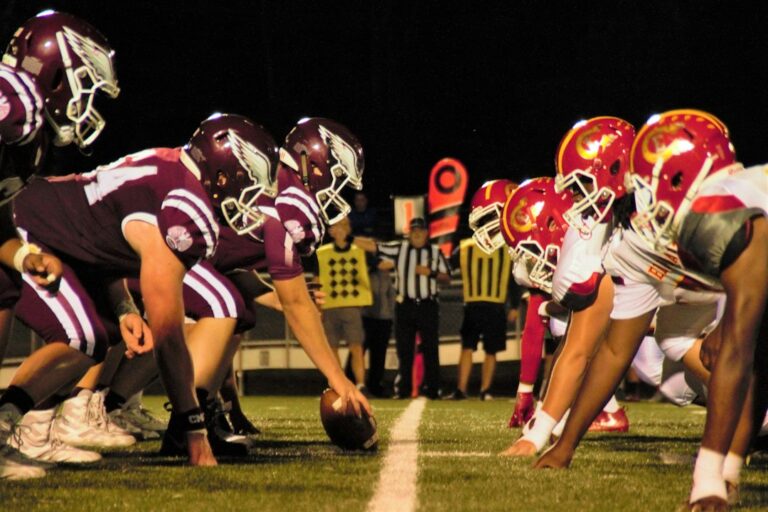
Before the snap, start with the quarterback and offensive line. Then count the running backs, tight ends and wide receivers around them. On defense, identify the defensive front, the linebackers behind it and the defensive backs farther outside or downfield. With practice, formations that once looked like 22 moving players begin to look like coordinated units with recognizable assignments.
Keep learning the NFL
Positions are one part of the larger structure of pro football. Next, read SportsyVibe’s guide to NFL divisions, conferences and the playoffs and explanation of the NFL catch rule.
Source note: Position descriptions and formation terminology were checked against current NFL Football Operations football-basics materials. Rules, roster usage and terminology can evolve, so SportsyVibe rechecks time-sensitive details when updating this guide.